

Gathering the right NDIS access request documents is one of the most important steps in applying for the scheme. One of the most common reasons NDIS access requests are delayed or rejected is not ineligibility. It is insufficient or poorly framed documentation.
A letter from a GP confirming a person has autism, cerebral palsy, or a mental health condition is a starting point, but it is rarely enough on its own. The NDIA needs to understand how that condition affects the person's daily life and functioning. That requires a specific type of evidence, gathered from the right professionals, and framed in the right way.
This guide explains exactly what NDIS access request documents you need, why each type matters, and how to put together a submission that gives your application the best chance of success.
The Two Categories of Evidence the NDIS Needs
When preparing NDIS access request documents, it helps to think in two categories: evidence of disability and evidence of functional impact.
Evidence of disability confirms that the person has a diagnosed condition or impairment. This comes from medical professionals such as a GP, specialist, or psychiatrist. It establishes what the condition is and that it is likely to be permanent.
Evidence of functional impact explains how that condition affects the person's ability to manage daily life. This comes from allied health professionals such as occupational therapists, speech pathologists, physiotherapists, or psychologists. It describes what the person can and cannot do independently across key areas of daily functioning.
Both categories are required for complete NDIS access request documents. An application that only provides one or the other is incomplete and will almost certainly require follow-up from the NDIA, which delays the decision and can lead to rejection if the additional evidence is not provided within the required timeframe.
Medical and Diagnostic Evidence
Medical evidence is typically the starting point for NDIS access request documents. It confirms the diagnosis, establishes that the condition is caused by an impairment, and supports the case that the impairment is likely to be permanent.
Useful medical evidence includes:
A letter or report from a treating GP, specialist, or psychiatrist that names the diagnosis, describes the underlying impairment, and states that the condition is likely permanent
Diagnostic assessment reports from specialists such as paediatricians, neurologists, or psychiatrists
Hospital discharge summaries or clinical correspondence that describe the nature of the condition and its long-term prognosis
Radiology or pathology reports where they directly support the diagnosis
The medical evidence does not need to be recent if the condition has been stable for some time. What matters is that it clearly establishes the diagnosis and confirms the permanent or likely permanent nature of the impairment.
Functional Assessment Evidence
Functional assessment evidence is the most important category of NDIS access request documents. It is also the one most commonly missing or underdeveloped in unsuccessful applications.
The NDIA assesses access based on whether a person's impairment substantially reduces their functional capacity across one or more of six areas: communication, social interaction, learning, mobility, self-care, and self-management. Medical evidence establishes the impairment. Functional assessment evidence demonstrates how that impairment reduces capacity across these areas.
The strongest functional assessments come from:
Occupational therapists (OTs): OT assessments are among the most useful NDIS access request documents available. A thorough OT report describes in practical terms what a person can and cannot do in their daily environment, and explains how their impairment creates those limitations.
Speech pathologists: For participants with communication or swallowing difficulties, speech pathology assessments are often the clearest evidence of functional impact in the communication domain.
Physiotherapists: Where mobility or physical function is affected, physiotherapy assessments provide specific evidence of what the person can and cannot do physically.
Psychologists: For participants with cognitive, intellectual, or psychosocial disability, psychological assessments provide standardised evidence of functional capacity across learning, social interaction, and self-management domains.
The NDIS also has a Supporting Evidence Form that treating health professionals can complete. You can find this form on the NDIS website along with detailed guidance on the evidence the NDIA uses to make access decisions. This form is specifically designed to capture the information the NDIA needs to assess an access request. Asking your treating professionals to use this form can make your submission more straightforward to assess.
Evidence for Specific Disability Types
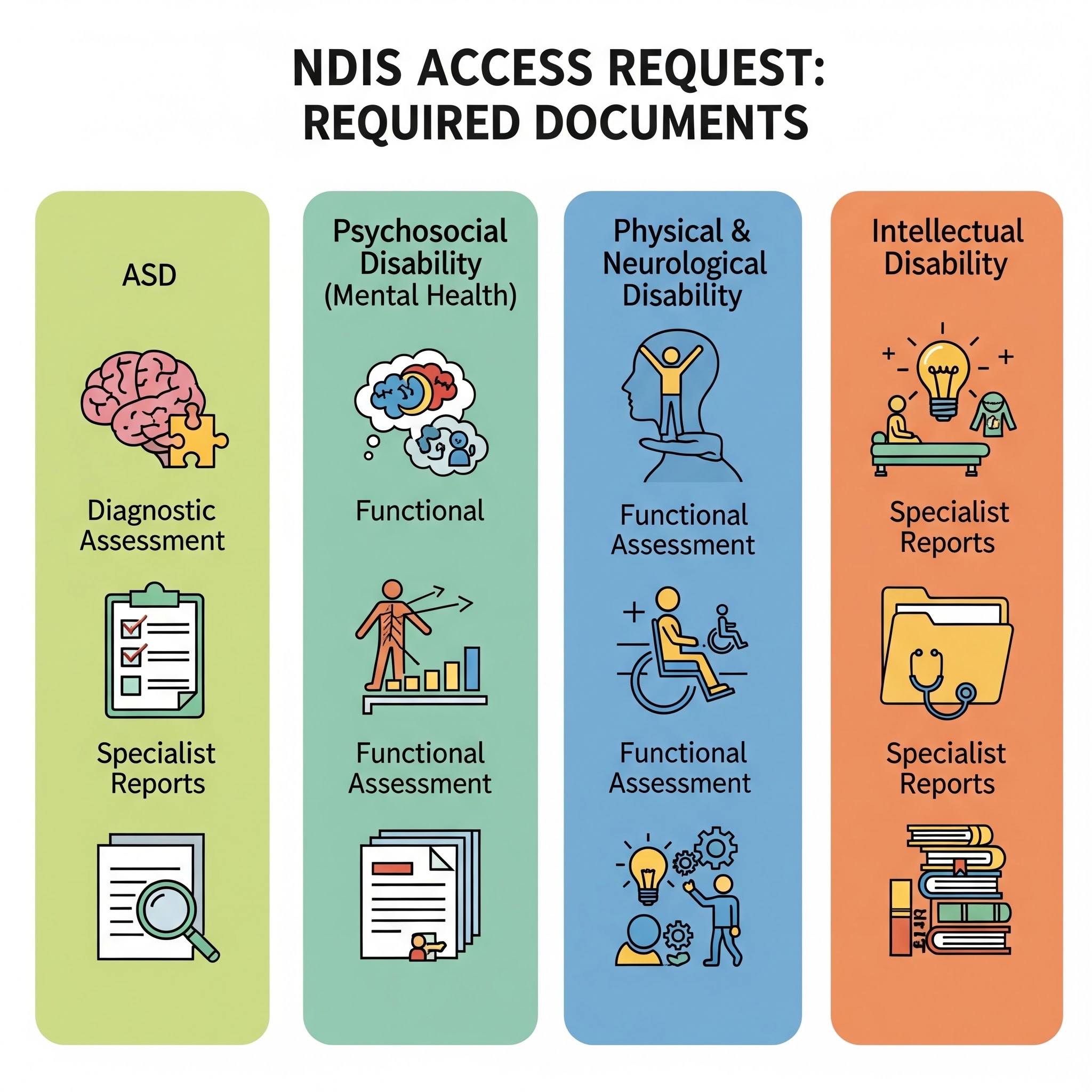
The right mix of NDIS access request documents varies depending on the type of disability being evidenced.
Autism Spectrum Disorder (ASD): A formal diagnostic assessment using recognised tools such as the ADOS-2 or ADI-R, completed by a paediatrician or psychologist, is the foundation. This should be paired with a functional assessment from an OT or psychologist that describes the impact on communication, social interaction, and daily living skills.
Psychosocial disability (mental health): Evidence from a psychiatrist or GP confirming the diagnosis and its likely permanence, combined with a psychological or OT functional assessment describing the impact on self-management, social participation, and daily living. Psychosocial applications can be more complex to evidence because functioning often fluctuates. Assessments that describe functioning at the person's baseline, not at their best, are more accurate.
Physical and neurological disability: Medical reports from treating specialists, physiotherapy assessments describing mobility and physical function, and OT reports describing the impact on self-care and home management. For acquired brain injury, neuropsychological assessment may also be relevant.
Intellectual disability: Psychological assessment confirming the diagnosis and describing adaptive functioning across daily living, social, and communication domains. School-based assessments or reports from treating paediatricians are also useful.
Documents for Children and Early Intervention Applications
For children applying through the early intervention pathway, the NDIS access request documents required are slightly different. The focus is on demonstrating that the child has a condition likely to benefit from early support, rather than a permanent disability.
Useful documents for early intervention applications include:
Reports from a paediatrician or developmental specialist confirming the diagnosis or developmental concern
Reports from early childhood educators or intervention specialists describing the child's functioning and support needs in a group or educational setting
Speech pathology, OT, or physiotherapy assessments describing the child's current developmental level and the gap between their functioning and typical development for their age
Any relevant school or kindergarten reports that describe how the child participates and what additional support they require
For children with ASD, the diagnostic report is particularly important and should be completed by an appropriately qualified clinician using recognised assessment tools.
What Makes Evidence Strong or Weak
Not all NDIS access request documents carry the same weight. Understanding what makes evidence strong helps you gather the right reports before submitting.
Strong evidence:
| Weak evidence:
|
If your existing reports fall into the weak category, it is worth asking your treating professionals to provide updated documentation before submitting. A single strong functional assessment from an OT can make more difference to an NDIS access request than multiple pages of medical correspondence that only describe the diagnosis.
How to Gather Your NDIS Access Request Documents
Start by listing the health professionals who currently work with the person and who know their disability well. These are the people best placed to supply the NDIS access request documents you need. These are the people best placed to provide the evidence you need.
Contact each professional and explain that you are preparing an NDIS access request. Ask whether they can provide a report or letter that specifically addresses functional impact, or whether they are willing to complete the NDIS Supporting Evidence Form. Give them as much lead time as possible, as reports from busy clinicians can take several weeks to prepare.
If a participant does not have an existing OT or allied health relationship, this is a good time to arrange an assessment. An OT assessment specifically for the purpose of NDIS access request documents can be one of the most effective investments in the application process.
A Support Coordinator, or a registered provider like JS Choice, can help you identify which documents are missing and which professionals are best placed to provide them. Our NDIS access request support service is designed to help families navigate exactly this process.
How JS Choice Group Can Help
At JS Choice, we have supported many families in Melbourne's western and northern suburbs through the NDIS access request process. We know which documents carry the most weight, where the common gaps are, and how to work with treating health professionals to build a submission that accurately reflects the participant's needs.
If you are preparing NDIS access request documents and are unsure where to start, reach out to our team or explore our support coordination services. We are here to help you get it right the first time.
Related reading: